

Roughly 80% of the more than 1,200 firms previously registered under national crypto rules failed to secure a Crypto-Asset Service Provider (CASP) licence before the Markets in Crypto-Assets (MiCA) transitional window closed on July 1, 2026. Two weeks into the new regulatory era, early data paints a fragmented picture of user behavior and market response.
Volume Shifts Toward Licensed Platforms, OKX Claims
OKX reported a 158% increase in EU app downloads in the 12 days following June 24, when Binance withdrew its MiCA licence application in Greece and announced it would cease serving EU clients without proper authorization as of July 1. According to Sensor Tower data cited by OKX, this growth more than doubled the 70% average increase observed across ten MiCA-licensed exchanges during the same period.
Inflows from former Binance users surged by over 830% compared to the prior 12-day window, the exchange stated. OKX has held a full MiCA licence since January 2025. However, these figures reflect only activity on OKX’s own platform; no independent, market-wide analysis of post-MiCA user flows is currently available.
Most Users Unaware of Exchange Compliance Status
A July 13 survey by Paybis—a MiCA-licensed exchange—of more than 850 European crypto users found that 68.6% do not know whether their current exchange is MiCA-compliant. When selecting a new platform, users prioritized fees (31.8%) over Trustpilot and Google reviews (26.9%), personal recommendations (21.6%), and sign-up bonuses (19.7%).
Data Suggests Confusion Over Coordinated Migration
Viewed in isolation, neither dataset fully explains market dynamics. Together, they point to widespread confusion rather than deliberate user migration. Aggregate exchange balance data from Arkham Intelligence shows OKX and Binance holdings moving in tandem—rising and falling together—over the same two-week periods, rather than diverging as would be expected if funds were systematically shifting from Binance to OKX.
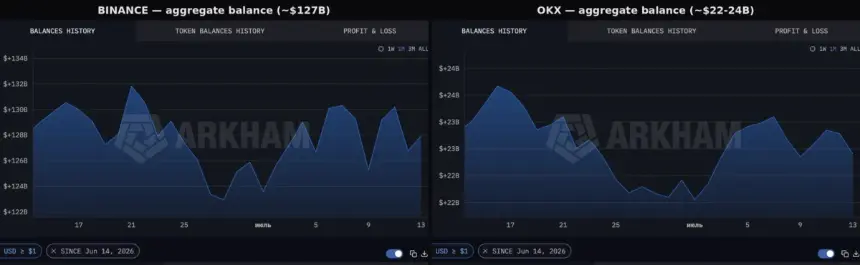
This pattern aligns more closely with broad market price movements than with a unidirectional flow of user assets. While the data isn’t segmented by region—and thus cannot confirm or rule out EEA-specific transfers—it does not substantiate the scale of migration described by OKX.
The ultimate shape of Europe’s post-MiCA landscape—whether consolidating around a few licensed exchanges, fragmenting into self-custody solutions, or involving orderly wind-downs of non-compliant firms—will become clearer as the European Securities and Markets Authority (ESMA) updates its official CASP register and issues licensing decisions for the remaining applicants in the coming weeks.