

Former U.S. President Donald Trump has called on the Senate to pass the Digital Asset Market Structure and Investor Protection Act—commonly known as the CLARITY Act—in memory of the late Senator Lindsey Graham, who died unexpectedly on July 11 at age 71 following a sudden cardiac event.
In a recent post on Truth Social, Trump emphasized the urgency for the United States to outpace China and other nations in both cryptocurrency adoption and artificial intelligence (AI) leadership. His appeal was supported by Senator Cynthia Lummis and Commodity Futures Trading Commission (CFTC) Chairperson Mike Selig.
Senator Graham, once a vocal critic of Trump during the 2016 election cycle, later became one of his closest allies in the Senate. Among Graham’s key legislative priorities were the CLARITY Act and bills promoting the safe and responsible development of AI and emerging technologies, which he viewed as essential to maintaining U.S. global competitiveness.
However, the CLARITY Act now faces significant legislative hurdles. Disagreements over ethical considerations, stablecoin yield mechanisms, and anti-money laundering (AML) provisions have stalled progress. Senators Angela Alsobrooks and Elizabeth Warren have voiced specific concerns regarding public officials’ holdings of certain digital assets and potential conflicts of interest tied to the Trump family’s cryptocurrency ventures.
As a result, the probability of the bill becoming law in 2026 has dropped sharply to just 40%, down from a peak of 90% earlier this year, according to prediction market data from Polymarket.
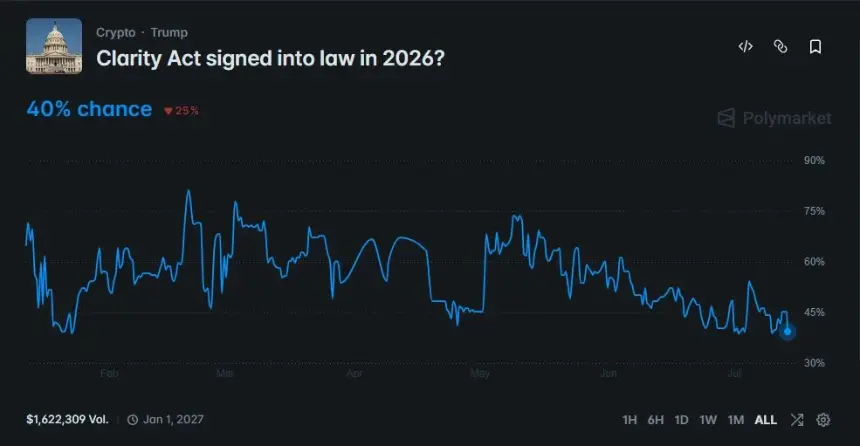
The Senate recently reconvened after recess and has only a narrow 20-day window to advance the legislation before its August break. Missing this deadline could delay further debate until after the September mid-term elections, when legislative focus may shift dramatically.
Meanwhile, the House Financial Services Subcommittee on Digital Assets has scheduled a hearing on July 17 to review the draft framework of the bill.