

MicroStrategy, now rebranded as Strategy, has unveiled the Bitcoin Banking Adoption Index, a new benchmark measuring how deeply the world’s largest banks are integrating Bitcoin (BTC) into their operations. The index reveals that overall institutional adoption currently stands at 32%.
The index evaluates 25 major global banks across four key categories: trading and custody, Bitcoin-linked products (including spot Bitcoin ETFs and stablecoins), lending services, and executive-level support. Each bank receives a composite score reflecting its engagement with the Bitcoin ecosystem.
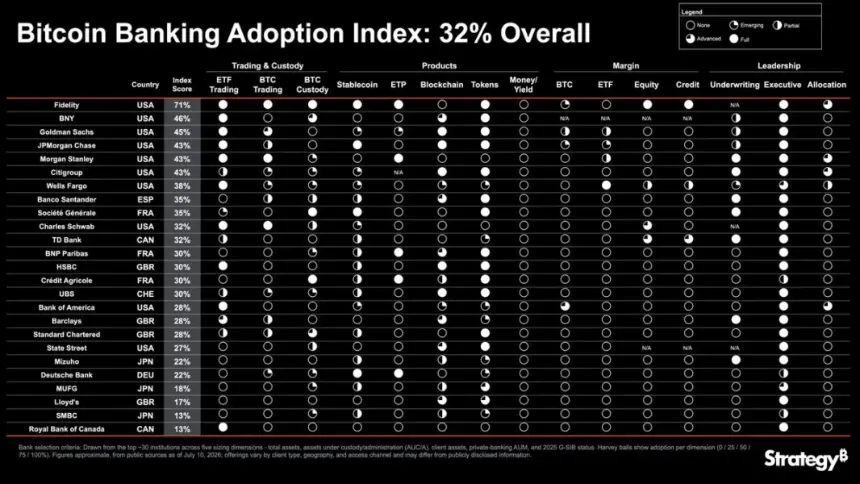
Fidelity emerges as the clear leader with a score of 71%, thanks to its early entry into digital assets through Fidelity Digital Assets—launched in 2018—and its recent launch of a spot Bitcoin ETF following U.S. regulatory approval in January 2024.
Other U.S. financial giants follow closely behind: BNY Mellon scores 46%, Goldman Sachs 45%, and JPMorgan, Morgan Stanley, and Citigroup each hover around 43%. European banks like Banco Santander and Société Générale rank modestly at approximately 35%, while Japanese institutions such as SMBC and Canada’s Royal Bank trail significantly at just 13%.
Michael Saylor, Executive Chairman of Strategy, commented: “Major-bank Bitcoin adoption is accelerating, but still early: 32% overall as measured by the index.” He emphasized that the data, compiled from public sources as of July 10, is approximate and subject to refinement.
Strategy itself holds a vested interest in broader Bitcoin adoption—it owns 843,775 BTC, the largest corporate Bitcoin treasury globally. The company published the index independently, invited feedback for corrections, and plans to release detailed methodology and periodic updates.
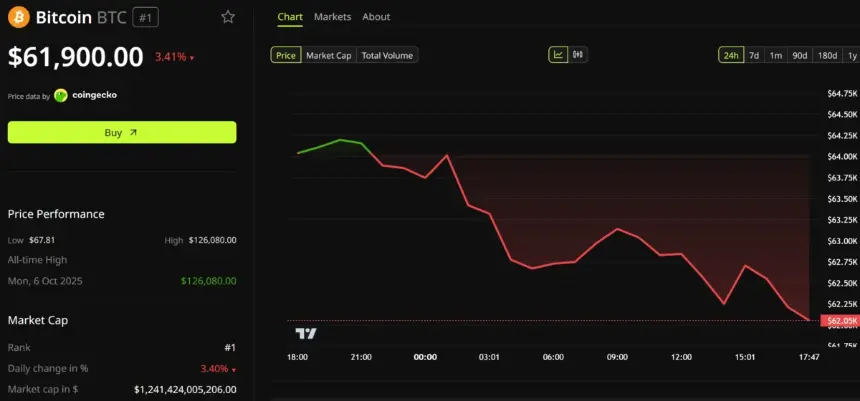
At the time of reporting, Bitcoin traded near $61,900, down more than 3% on the day. Despite short-term volatility, Saylor maintains a long-term bullish outlook, anticipating deeper integration of Bitcoin across the banking sector.