

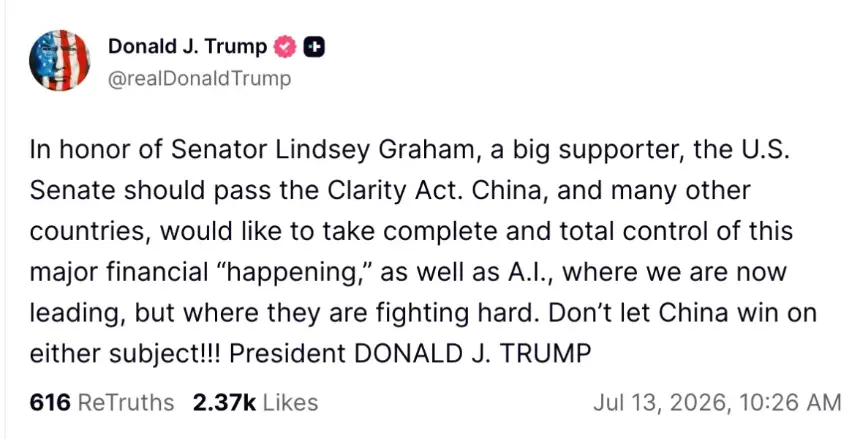
Former President Donald Trump pressed the U.S. Senate on Monday to pass the Digital Asset Market Clarity Act (CLARITY Act), warning that failure to act would hand China a decisive advantage in the global competition over cryptocurrency and artificial intelligence (AI).
In a post on Truth Social, Trump urged lawmakers to advance the bill "in honor of" the late Senator Lindsey Graham (R-SC), a staunch supporter of the legislation. He emphasized that China and other nations are aggressively pursuing "complete and total control" of both crypto and AI sectors, and cautioned that U.S. inaction would allow Beijing to gain critical ground.
White House crypto adviser Patrick Witt reinforced the urgency, calling the current week "critical" for the CLARITY Act’s progress. In a post on X, Witt noted that the week also marks the first anniversary of the GENIUS initiative, adding, “It’s a reminder of the incredible amount of hard work that has gone into this bill, but also of the time we’ve already lost. We cannot afford to delay any longer.”
The Senate returned from recess with approximately four weeks before its August break—widely viewed as the final realistic window to pass the bill during the 119th Congress. According to the newsletter Crypto in America, two key hurdles remain: finalizing language in the Blockchain Regulatory Certainty Act (BRCA) provision—which aims to protect non-custodial developers from being classified as money transmitters—and resolving an ethics dispute concerning potential conflicts tied to Trump’s own crypto business interests. Senator Thom Tillis (R-NC), who reported over $1 billion in crypto-related earnings last year, is central to this debate.
With Senator Graham’s recent passing and Senate Minority Leader Mitch McConnell (R-KY) still absent, Republicans face a narrow margin for securing the 60 votes needed to overcome procedural hurdles.
Industry reactions remain divided. Kristin Smith, President of the Solana (SOL) Policy Institute, expressed cautious optimism: “Nothing in Congress is ever certain, but I’m confident we have a real path to getting the Clarity Act signed into law... momentum is certainly building toward a floor vote.” Conversely, Alex Thorn, Head of Research at Galaxy Digital (GLXY), estimated only a 50% chance of passage, citing a compressed legislative calendar and competing priorities such as the National Defense Authorization Act.