

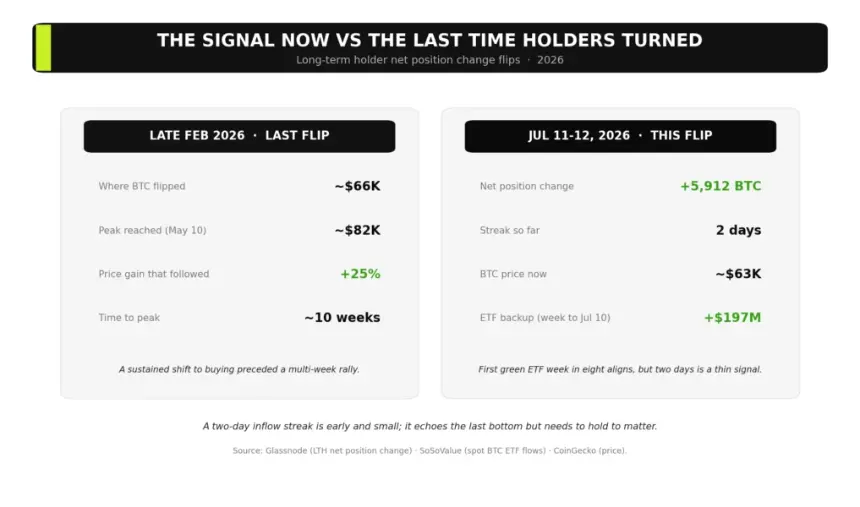
Bitcoin’s price is sliding, but its most patient owners are doing the opposite of panicking. After 12 consecutive days of net selling, long-term holders (LTHs) of Bitcoin BTC resumed accumulation on July 11 and 12, adding a net 5,912 BTC.
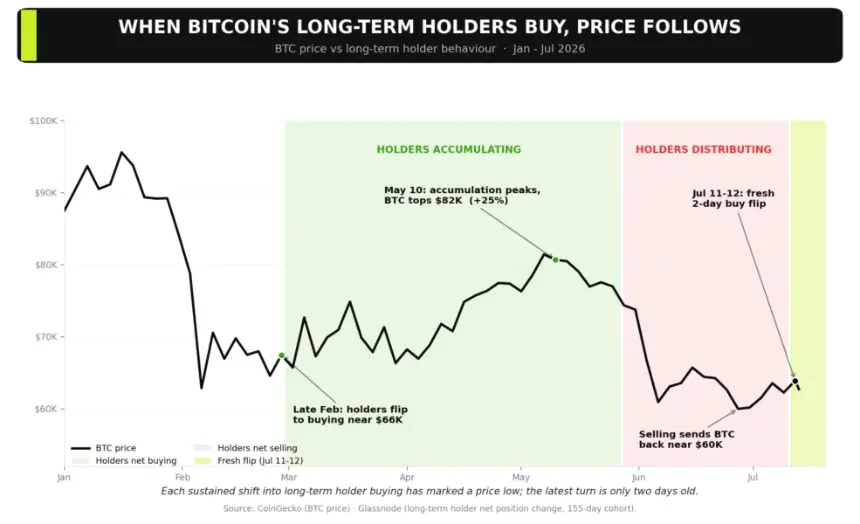
While modest in scale and only two days old—and with BTC still down 2% over the past 24 hours—the shift marks the first reversal from selling to buying since late February. That earlier flip preceded a 25% rally that carried Bitcoin from around $65,896 to a May peak near $82,186.
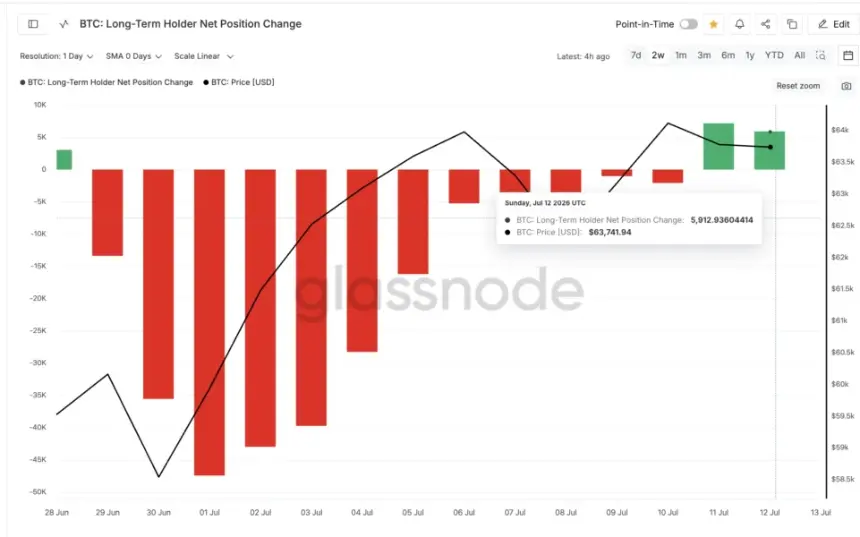
On-chain analytics firm Glassnode defines long-term holders as wallets holding coins for approximately 155 days or more. A positive reading in its “long-term holder net position change” metric indicates these investors are acquiring BTC faster than they’re selling it—a behavior rarely driven by short-term market noise.
Their return to accumulation effectively removes supply from the market, tightening conditions and potentially creating upward price pressure. For the prior 12 days, the metric had been negative, signaling LTHs were offloading coins into a weakening market. The recent flip halts that outflow—at least temporarily.
Currently trading near $62,717 (down ~2% on the day), Bitcoin is being bought by LTHs during weakness rather than strength—a historically bullish posture.
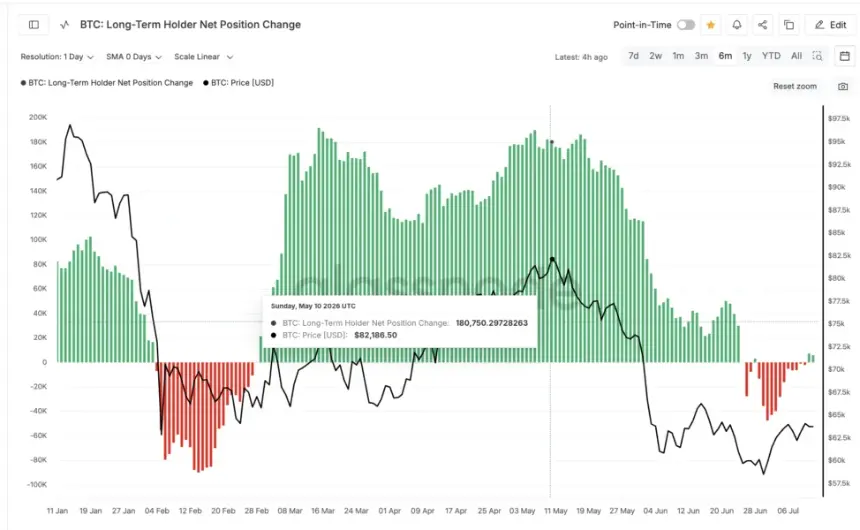
The February bottom followed a similar pattern: LTH accumulation began before price recovery, not after. In fact, in both the current and February scenarios, the behavioral shift among long-term holders led price action—not the reverse.
Adding credibility to this signal is a second concurrent development: U.S. spot Bitcoin ETFs recorded $197 million in net inflows during the week ending July 10—their first positive week after eight straight weeks of outflows. Since ETF purchases involve actual spot BTC acquisition, this represents real demand entering the market.
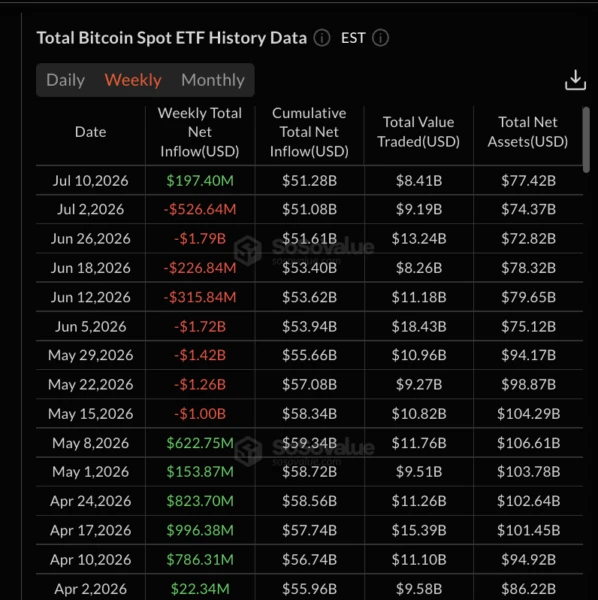
The convergence of LTH accumulation and ETF inflows suggests a broader base of support is forming. Some analysts speculate that long-term holders may even be interpreting the ETF turnaround as a confirmation signal.
However, caution remains warranted. A two-day buying streak is fragile. If accumulation stalls or reverses in the coming days, the signal could fizzle, and downward momentum may resume. Historically, the February signal persisted for weeks before price responded meaningfully.
For now, Bitcoin’s oldest hands are standing firm near $62,700. Whether this marks the start of another sustained climb hinges on whether their buying conviction holds through the coming week.