

A new study by the University of Cambridge places Ethereum near the lower end of energy intensity among major proof-of-stake (PoS) blockchains, even though it consumes more total electricity than most peers in the category.
The Cambridge Centre for Alternative Finance estimates that Ethereum uses approximately 7.87 gigawatt-hours (GWh) of electricity annually. When normalized by market value, the network consumes about 33 kilowatt-hours (kWh) per $1 million—a figure second only to BNB Chain among the PoS networks analyzed.
In contrast, Solana emerged as the most energy-intensive network in the study, drawing roughly 13.48 GWh per year and registering an energy intensity of around 283 kWh per $1 million—more than 8.5 times that of Ethereum. Collectively, the PoS networks examined in the report account for about 38 GWh of annual electricity consumption.
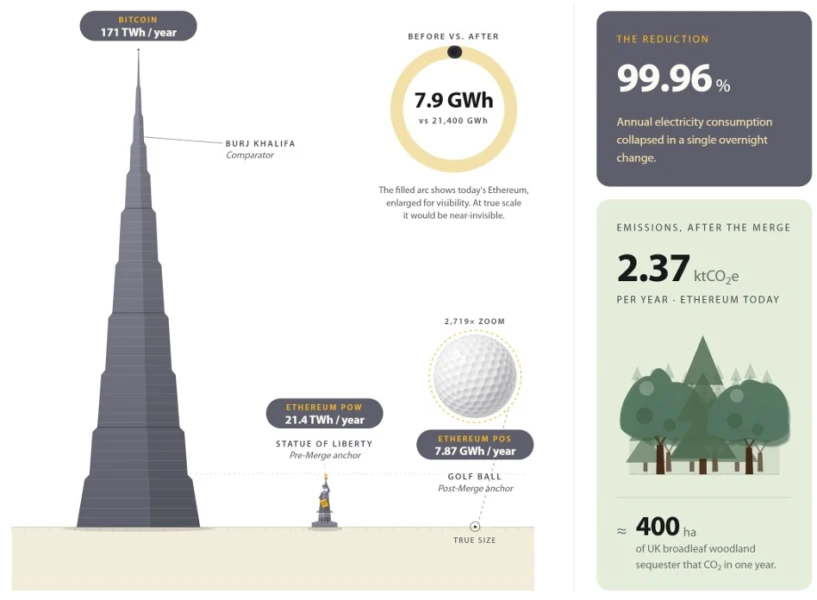
The findings offer one of the most detailed assessments to date of Ethereum’s post-Merge environmental footprint, providing updated data for policymakers and investors evaluating blockchain sustainability. The network’s transition from proof-of-work (PoW) to PoS in September 2022 slashed its energy use by approximately 99.96%.
The Merge replaced energy-intensive mining with a validator-based system where participants secure the network by staking Ether. Cambridge researchers measured electricity consumption across 20 combinations of Ethereum’s primary software clients, finding that a typical home node draws about 18 watts, while a high-performance workstation uses roughly 153 watts. Factoring in the mix of residential and professionally hosted nodes, the average power draw per node is estimated at 105 watts.
The study identified approximately 8,522 discoverable full nodes, with 64% operating in cloud or enterprise environments and 36% on residential connections. According to Cambridge, Ethereum’s residual emissions are now primarily dictated by the carbon intensity of local electricity grids powering these nodes.
Notably, the report estimates that 56.4% of the electricity used by the Ethereum network comes from renewable and nuclear sources, while 43.6% is derived from fossil fuels.