
Market veterans are divided over MicroStrategy Executive Chairman Michael Saylor’s Bitcoin strategy and personal credibility following the company’s shift from being a net buyer to a net seller of Bitcoin—and Saylor’s reported sale of approximately $370 million in MSTR shares in 2024.
During a debate at QTR’s Fringe Finance event, financial commentator Chris Irons accused Saylor of “talking out of both sides of his mouth.” Irons, known for his skepticism toward passive investing and market distortions driven by options flows, drew parallels between Saylor’s recent actions and executives he previously investigated as short-selling targets. He argued that such leaders often “change the narrative when it doesn't work for them” and stop disclosing key metrics once they turn unfavorable.
Irons pointed specifically to Saylor’s earlier pledge that MicroStrategy would “be buying every quarter forever,” a claim that no longer holds after the company unveiled its new “Bitcoin monetization strategy” and began selling Bitcoin. He also noted that MicroStrategy has scaled back public references to its once-prominent “Bitcoin yield” metric as the figure declined in recent weeks.
Adding to credibility concerns, Irons highlighted Saylor’s sale of roughly $370 million worth of MSTR shares in 2024 through a pre-arranged trading plan allowing the offloading of up to 400,000 shares. Despite the controversy, MSTR stock closed up 0.80% on Friday, with retail sentiment on Stocktwits remaining in the ‘neutral’ zone and discussion volume staying low.
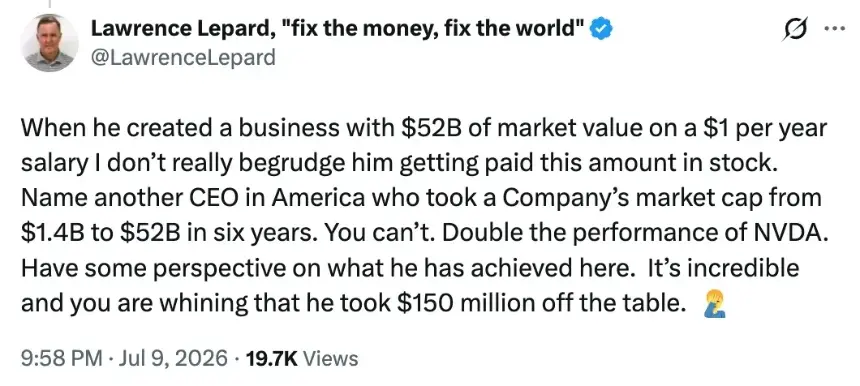
In contrast, veteran investor Lawrence Lepard defended Saylor, emphasizing the extraordinary value he has created for shareholders. On X (formerly Twitter), Lepard wrote: “When he created a business with $52 billion of market value on a $1 per year salary, I don't really begrudge him getting paid this amount in stock.”
Lepard noted that MicroStrategy’s market capitalization surged from about $1.4 billion to $52 billion over six years—a performance he claimed “doubled” that of Nvidia (NVDA) during the same period. He argued that critics lack perspective on Saylor’s achievements before condemning his decision to take profits.
Both Irons and Lepard agreed, however, that MicroStrategy’s leveraged corporate structure makes holding MSTR stock riskier than owning Bitcoin directly.